

Sustainable Cosmetic Packaging Market Set To Surge Beyond $574.7 Billion By 2033 Driven By Global Eco Shift - SRI
Sustainable Cosmetic Packaging Market
Sustainable cosmetic packaging market to reach $574.7 billion by 2033 driven by eco innovation, regulatory pressure, and rising consumer demand.
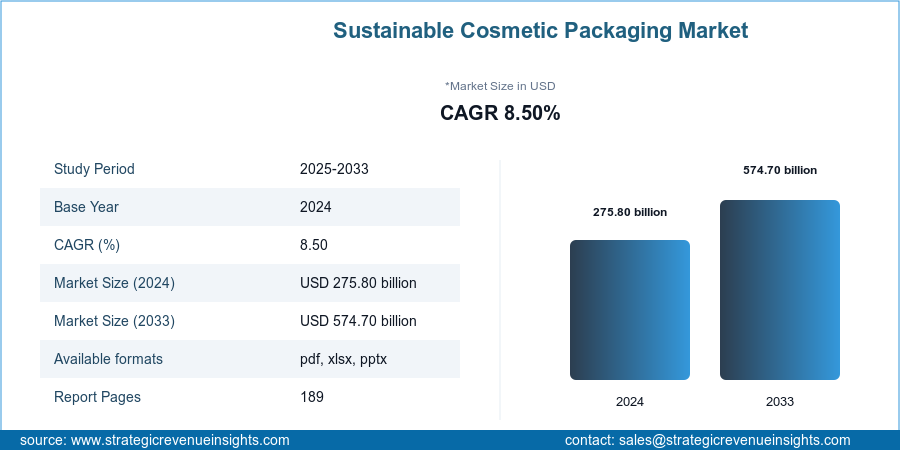
LONDON, UNITED KINGDOM, UNITED KINGDOM, December 2, 2025 /EINPresswire.com/ -- London, UK - December 2025 | Strategic Revenue Insights Inc. - The sustainable cosmetic packaging market is entering a decisive phase of global expansion, fueled by rising consumer expectations, regulatory momentum, and rapid transformation in material science. The category has shifted from a niche sustainability initiative to a structural force that is reshaping every major beauty and personal care segment. With market size reaching 275.80 billion USD in 2024 and expected to climb to 574.70 billion USD by 2033, sustainable packaging has become one of the most dominant growth narratives in modern beauty.According to the latest industry intelligence available at Sustainable Cosmetic Packaging https://www.strategicrevenueinsights.com/industry/sustainable-cosmetic-packaging-market, brands across mass, masstige, luxury, and professional channels are recalibrating their packaging ecosystems to align with global expectations for circularity, material transparency, and environmental responsibility. This shift is not driven by regulation alone. It reflects a deeper consumer transformation where packaging is now central to brand loyalty, ethical perception, and long term value.
The momentum behind this market reflects a broader transition in how beauty consumption is defined. Sustainability is no longer limited to clean ingredients or green claims on labels. Packaging now holds a central role in shaping perception of product integrity, environmental sensitivity, and brand maturity. Consumers view packaging waste as one of the most visible environmental footprints of the beauty industry. As a result, refillable formats, mono material designs, fully recyclable structures, and plant based substrates have rapidly gained influence. This evolution is supported by a new generation of consumers who are attentive to the afterlife of products they buy. These behaviors provide clarity on why sustainable cosmetic packaging is evolving from an optional corporate initiative to a mandatory competitive standard for brands seeking global relevance.
Browse the associated report:
https://www.strategicrevenueinsights.com/ja/industry/sustainable-cosmetic-packaging-market
https://www.strategicrevenueinsights.com/kr/industry/sustainable-cosmetic-packaging-market
https://www.strategicrevenueinsights.com/pt/industry/sustainable-cosmetic-packaging-market
https://www.strategicrevenueinsights.com/it/industry/sustainable-cosmetic-packaging-market
https://www.strategicrevenueinsights.com/es/industry/sustainable-cosmetic-packaging-market
https://www.strategicrevenueinsights.com/da/industry/sustainable-cosmetic-packaging-market
https://www.strategicrevenueinsights.com/de/industry/sustainable-cosmetic-packaging-market
https://www.strategicrevenueinsights.com/fr/industry/sustainable-cosmetic-packaging-market
Market Trends
The present market trends surrounding sustainable cosmetic packaging highlight the convergence of sustainability, consumer behavior, digital influence, and premiumization. One of the most visible shifts is the movement toward minimalist packaging. Consumers increasingly associate simplicity and material transparency with authenticity and safety. They value packaging that uses fewer components and avoids mixed materials that complicate recycling. This trend is shaping decisions for jars, tubes, pumps, and dispensers where brands are redesigning structures to support efficient recovery. Another strong trend is the rise of refill ecosystems. Luxury and mass brands alike are launching refill compatible product lines, focusing on durable outer shells paired with lightweight, low impact refill units. These systems are aligned with the broader circular economy expectations and help brands reduce recurring packaging footprint.
Consumer preferences have also shifted toward high quality reusable materials such as glass and metal, which evoke timelessness and premium identity. Glass remains one of the fastest expanding segments within sustainable cosmetic packaging due to its infinite recyclability and consumer trust in its purity and safety. Metal, often used in compacts, atomizers, and high end applicators, also continues to rise due to its long life cycle and durability. In parallel, paper based structures are gaining strength in secondary packaging, cartons, sleeves, and molded fiber trays. Paper is seen as a low impact and versatile choice, especially when certified by responsible forestry standards.
Another trend reshaping the market is the rise of digital sustainability verification. Customers want to understand packaging origin, recyclability, carbon footprint, and disposal pathways. This demand has pushed brands to employ QR codes, traceability markers, and digital product passports. These tools allow companies to highlight environmental achievements without adding physical materials or layers to packaging. The combination of material innovation and digital affirmation captures the deeper shift underway in consumer expectations, particularly among younger demographics who expect packaging to speak the same sustainability language as the product itself.
Technological Advancements
Advancements in material science are accelerating the pace of change. The industry is now seeing breakthroughs in biodegradable polymers, next generation bio plastics, plant based resins, and novel fiber composites. These materials are engineered to maintain performance qualities such as durability, stability, barrier properties, and compatibility with active cosmetic formulations. One of the fastest rising technologies is PHA, a naturally occurring polymer produced through microbial fermentation. PHA offers biodegradability without leaving microplastic residue. Another emerging material is bio PET, created from renewable plant based feedstock instead of fossil resources. This material maintains identical characteristics to conventional PET but supports lower carbon impact.
Smart packaging technologies are beginning to influence beauty brands that want to enhance consumer interaction while reducing wastage. These systems include embedded sensors to measure usage levels, dose precision systems that reduce over dispensing, and smart closures that improve product longevity. Automated dispensing solutions enhance efficiency and minimize product leakage or overuse. The expansion of automation within production processes is also transforming the landscape. Modern machinery supports reduced material waste, uniform wall thickness in bottles and jars, and precise alignment across closures and applicators. These optimizations help manufacturers achieve better cost to output ratio despite using higher priced sustainable substrates.
Recycling technologies are advancing at a rapid pace. Mechanical recycling has improved, but chemical recycling is gaining attention. Chemical recycling allows plastic waste to be broken down into molecular components and remade into virgin quality material. This innovation opens the door for high performance recycled content in cosmetic grade packaging, where clarity, purity, and safety are non negotiable. Similarly, progress in aluminum recycling and high precision glass molding supports the industry's push toward circularity. Even dispensing systems that traditionally rely on complex combinations of metal, plastic, and rubber are now being re engineered using mono material or simplified configurations.
Sustainability Challenges
Despite strong market momentum, the sector faces several challenges. One major issue is cost. Sustainable materials such as glass, metal, and bio based plastics often cost significantly more than traditional petrochemical plastics. This pricing gap can be difficult for small and medium enterprises to absorb. Another challenge is sourcing. Many bio based and recycled materials do not have consistent availability across global markets. Supply chain disruptions also affect the reliability of sustainable material flows.
Recycling infrastructure remains uneven across regions. Even if packaging is technically recyclable, it is not always processed as such due to regional infrastructure gaps. According to global waste management assessments, more than 70 percent of plastic packaging waste is not recycled, and much of it enters landfills or incineration routes. In the cosmetic sector, where packaging complexity tends to be higher, recyclability becomes difficult when multiple materials are fused. Pumps, droppers, and airless systems often combine metal springs, silicone components, and composite plastics.
The lack of standardized global regulations further complicates the sustainability landscape. Brands must navigate varying requirements related to recyclability claims, labeling standards, and post consumer recycled content. Some regions enforce strict extended producer responsibility, while others have minimal standards. This inconsistency forces companies to maintain multiple compliance strategies for different markets. At the same time, environmental claims are under heightened scrutiny. Regulatory bodies in the United States, Europe, and Asia are monitoring brands for misleading sustainability communications. This creates pressure for companies to ensure packaging claims are backed by verifiable data.
Despite these challenges, progress continues. Global brands are establishing cross industry collaborations to improve recycling systems, invest in circular material innovation, and create large scale recovery programs. New industry coalitions are working to increase recycled content availability while supporting next generation recycling technology deployment.
Market Analysis
The sustainable cosmetic packaging market is supported by strong fundamentals across geography, materials, and product categories. North America remains one of the leading regions, supported by advanced recycling frameworks and strong consumer demand for eco conscious beauty products. Europe continues to set regulatory benchmarks that shape global adoption. Markets such as Germany and France remain influential due to their heritage in cosmetic excellence and environmental leadership. Asia Pacific is now the fastest growing region due to rising middle class consciousness, strong local manufacturing ecosystems, and government initiatives targeting plastic reduction.
Key companies within the competitive landscape include Amcor, Gerresheimer, Albea Group, AptarGroup, Berry Global, and Sealed Air. These players are investing in research, recycling partnerships, and product innovation. Many have established public sustainability commitments tied to 2025 or 2030 goals. Examples include targets to increase recycled content, reduce virgin plastic, achieve full recyclability of product portfolios, or shift toward bio based substrates.
The market is forecast to double over the next decade due to multiple converging forces. The rise of ecommerce reinforces demand for protective yet sustainable packaging. Luxury brands are emphasizing refill systems and high durability materials that strengthen brand identity. Mass brands are investing in lightweight and recyclable components that reduce transport emissions and improve shelf presence. The clean beauty movement is encouraging brands to rethink packaging design as an integral part of product storytelling. These factors collectively ensure that sustainable cosmetic packaging will remain a core driver of competitive differentiation across the global beauty ecosystem.
Future Outlook
The future outlook for sustainable cosmetic packaging points toward greater alignment with advanced environmental metrics, precise material selection, and next generation design strategies. Regulatory evolution will continue to intensify. Many regions are preparing stricter guidelines that require brands to disclose recyclability data, post consumer recycled content, and environmental impact indicators. Companies will need to integrate sustainability at the earliest phases of packaging design rather than treat it as a retrofit.
Material science will continue expanding options. The next wave of innovation may include seaweed based films, agricultural waste derived polymers, carbon negative materials, and high performance refill pouches. Digital verification systems will deepen consumer engagement by offering transparent lifecycle data. Brands will increasingly implement digital product passports to demonstrate traceability and environmental progress.
Market demographics will also shape future direction. Younger consumers consistently show stronger preference for brands that demonstrate tangible environmental responsibility. Their influence will drive the adoption of circular business models, refill stations, take back programs, and local recovery partnerships. This demographic shift will influence product design, brand positioning, and marketing communication for years to come.
Sustainable cosmetic packaging has become a defining pillar of the modern beauty industry. Its growth underscores a larger global movement toward responsible production, material transparency, and environmental accountability. The combination of consumer expectations, regulatory pressure, and technological progress has created an environment where sustainability is both a moral imperative and a commercial opportunity. The next decade of beauty innovation will be shaped by how effectively brands embrace circularity, design intelligence, and eco focused manufacturing. Companies that invest early stand to achieve long term consumer trust, market relevance, and operational resilience.
Readers can explore additional insights and broader industry intelligence through Strategic Revenue Insights https://www.strategicrevenueinsights.com which provides analytical depth on packaging, materials, and sustainability driven markets.
Related and Popular Reports:
https://www.strategicrevenueinsights.com/industry/paper-packaging-sustainable-barrier-coating-market
https://www.strategicrevenueinsights.com/industry/paper-sustainable-packaging-market
https://www.strategicrevenueinsights.com/industry/plastic-sustainable-packaging-market
https://www.strategicrevenueinsights.com/industry/sustainable-green-packaging-market
https://www.strategicrevenueinsights.com/industry/sustainable-food-packaging-market
https://www.strategicrevenueinsights.com/industry/sustainable-high-barrier-paper-market
https://www.strategicrevenueinsights.com/industry/sustainable-labels-market
https://www.strategicrevenueinsights.com/industry/sustainable-packaging-market
https://www.strategicrevenueinsights.com/industry/sustainable-packaging-solutions-market
https://www.strategicrevenueinsights.com/industry/sustainable-paper-market
https://www.strategicrevenueinsights.com/industry/sustainable-plastic-wrapping-market
About Us:
Strategic Revenue Insights Inc., a subsidiary of SRI Consulting Group Ltd, empowers organizations worldwide with data-driven market intelligence. Headquartered in London, United Kingdom, we deliver syndicated research reports, tailored consulting solutions, and actionable insights that equip clients to make confident, future-focused strategic decisions.
Our team of seasoned analysts—based in London and connected globally—continuously tracks markets, identifies emerging trends, and uncovers growth opportunities to support long-term client success. As part of SRI Consulting Group Ltd, we are committed to accuracy, clarity, and practical relevance, helping businesses navigate competitive landscapes, optimize strategies, and accelerate revenue growth.
By combining rigorous research methodologies with deep industry expertise, Strategic Revenue Insights Inc. provides organizations with a comprehensive market perspective that drives measurable results and sustained competitive advantage.
Media Contact:
Company Name: Strategic Revenue Insights Inc.
Contact Person: Ashwani
Email: sales@strategicrevenueinsights.com
Phone: +44 7877403352
Address: Suite10 Capital House 61 Amhurst Road, E8 1LL
City: London
State: London
Country: United Kingdom
Website: www.strategicrevenueinsights.com
Website: www.strategicpackaginginsights.com
Website: www.sriconsultinggroupltd.com
Rohit Bhisey
Strategic Revenue Insights Inc.
+44 7877 403352
sales@strategicrevenueinsights.com
Visit us on social media:
LinkedIn
Facebook
YouTube
X
Other
Legal Disclaimer:
EIN Presswire provides this news content "as is" without warranty of any kind. We do not accept any responsibility or liability for the accuracy, content, images, videos, licenses, completeness, legality, or reliability of the information contained in this article. If you have any complaints or copyright issues related to this article, kindly contact the author above.
